



CTO Playbook
“Can an enterprise software development company handle our sensitive financial or customer data?” This question might strike the mind of a financial company leader sitting in Midtown Manhattan when they are evaluating an enterprise software development partner. The business ecosystem of this area is unusually concentrated around financial services, law, professional services, technology, media, and large corporate headquarters.
According to Cushman & Wakefield’s Q2 2026 Manhattan Office MarketBeat, financial services led Midtown demand this year. It accounted for 37.5% of all new leases above 10,000 square feet signed year to date. The TAMI sector followed at 23.4%, with legal services close behind at 23.0%. That concentration means a meaningful share of software built or bought in this market handles regulated, high-stakes data. Getting this wrong can mean expensive rework, regulatory attention, or clients rethinking the partnership.
This blog discusses what enterprise-grade software actually requires in Midtown, and how to choose an enterprise software development company that can deliver it.
In Midtown Manhattan, using outdated software means compounding financial liability. When financial institutions, legal practices, and corporate enterprises delay modernizing their core systems, the result is escalating operational overhead, regulatory exposure, and lost ground to faster-moving competitors.
According to IBM’s 2025 Cost of a Data Breach Report, the average US data breach now costs $11.5 million, the highest of any country, and financial services remains one of the most heavily hit sectors worldwide at $6.29 million per breach. For a Midtown firm concentrated in exactly that data, operating on legacy architecture stacks compliance risk on top of an already elevated baseline. A breach involving outdated systems may trigger enforcement under NYDFS 23 NYCRR 500 and SEC Rule 17a-4. The result can go beyond the direct financial hit into mandatory notification and the legal cost of proving the gap has been closed.
While one firm is absorbing the cost of a rebuild or a compliance finding, a competitor down the block is already handling sensitive data as the standard regulators expect. This helps them close deals faster because no one is questioning their compliance record.
Enterprise-grade software is built to operate reliably under high security, compliance, integration, scale, and availability demands. The primary concerns of standard software are functionality and usability. But enterprise systems must fit into a larger technology and business ecosystem without becoming a new source of risk.
For example, a standard business app can run on basic password logins, a single database, and occasional security checks. Enterprise application development has higher demands. Software used by a bank, a law firm, or a company managing critical business systems has to protect sensitive data, control access, pass security checks, and keep running smoothly even during peak traffic. And this is the standard a custom enterprise software development partner should follow from the very beginning. Here is how enterprise-grade software has to be.
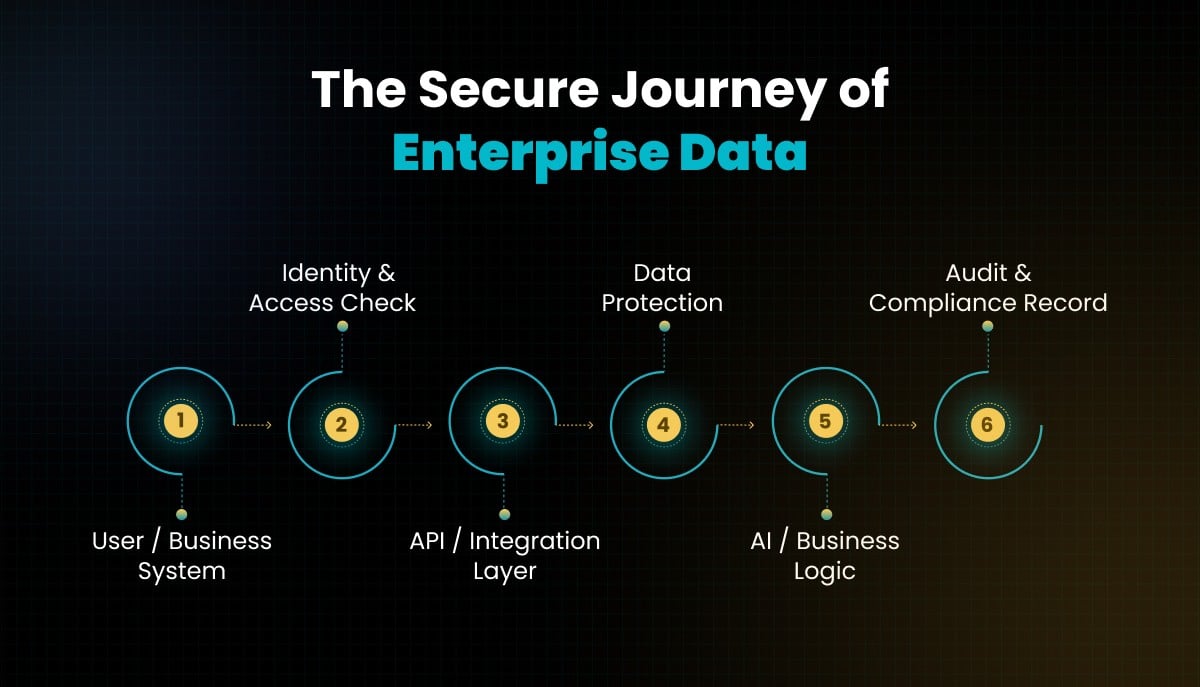
A standard app can use role-based access control (RBAC, two-factor login, and periodic security checks to protect its user data. But this is not enough when software integration services connect a system to sensitive financial or legal data across multiple teams. Zero-trust architecture is required here. It verifies and authorizes every session, identity, API call, and microservice interaction. Modern enterprise security architecture prioritizes passwordless authentication and immutable record-keeping.
For an enterprise platform in Midtown, compliance has to be mapped in before launch.
Enterprise application integration means connecting to ERPs, CRMs, and real-time data feeds all at once. Synchronous APIs strain under load, one slow system stalls the rest. Event-driven architecture decouples them, so traffic keeps flowing even when a service lags. The same discipline applies to AI. A small app can wrap a public model with minimal guardrails and call it done. But AI-enabled enterprise software needs stronger guardrails and proper governance.
Two shifts are changing how enterprise systems get built and maintained in Midtown right now. One in how legacy platforms get modernized, and one in how new systems get delivered in the first place.
A full system rewrite involves a huge investment. The safer path is to replace legacy functionality piece by piece and route traffic through a gateway to new services with zero downtime along the way.
Delay has its own cost too. Deloitte’s 2026 Global Technology Leadership Study found that technical debt accounts for 21% to 40% of an organization’s IT spending, and capacity is pulled away from new development the longer modernization gets delayed, regardless of how it eventually happens.
This is about how the development team builds the software. Companies using AI-assisted development, testing, and code review are delivering enterprise systems faster. But a good enterprise software development company should leverage AI to reduce repetitive work without cutting the security or compliance work covered earlier in this blog.
This shift is also where enterprise SaaS development and workflow automation platforms are heading next. Companies can still build and launch software faster while still meeting the same security, compliance, and audit requirements expected from a Midtown enterprise.
The right development company in NYC must have real regulatory experience, technical fluency with the systems this market actually runs on, and delivery, pricing, and contract terms built for the standard Midtown industries.
The development partner you choose must be able to build a system that has actually been through a NYDFS 23 NYCRR 500 audit. The system also should demonstrate zero trust and passwordless authentication running in a live environment.
Ask them to see the audit history and the live implementation. Learn how they handle Vendor Risk Management review before a contract is signed. If a vendor struggles with a routine vendor-risk review, that’s a fair warning of how they’ll handle a real regulatory examination later.
Don’t look for finished case studies; rather, ask them how they prove it works at scale with a live architecture walkthrough. That walkthrough should cover real experience connecting to what this market runs on specifically. Such systems include trading platforms for finance clients, case management for law firms, rights and licensing workflows for media companies. So, a custom enterprise software development partner with only retail or consumer app experience might not be a good choice here.
The presence of your development partner in Midtown Manhattan is an added advantage. A local software development company within walking distance can join an audit, manage an incident in person, or attend a compliance review on short notice. It is much easier to rely on them than some remote team that can’t match when a regulator wants answers fast.

The enterprise-level delivery process demands an agile enterprise software delivery backed by DevOps and CI/CD pipelines, with audit trails attached. Your project dashboard should provide enough detail for your security or compliance team to review the deployment history. This will help to trace exactly what changed, when, and who approved it, without waiting on the vendor to pull that information together during an actual audit.
If you get a transparent pricing structure, it becomes easier to make the decision. A vendor who is clear about pricing from the very beginning can easily explain the cost breakdown. So project scope changes might not become difficult to manage later. The contract should also clearly state that you own the code, documentation, and other work created for your project. It should also include clear support terms, response times, and what happens if something goes wrong after launch.
Want to see how different NYC vendors compare on these fronts?

As enterprise systems often handle proprietary financial or legal data from day one, full ownership of code, infrastructure configurations, and any custom-trained AI model matters more here than in a typical software contract. Recovery time and recovery point objectives need to be specific numbers written into the contract, especially where downtime carries regulatory reporting implications.
Once you consider these above-mentioned factors, you can separate a vendor who talks about enterprise-grade standards from one who’s actually built to them.
If you want to build enterprise-grade software in Midtown Manhattan, you need a software partner that operates with the same level of speed, security, and institutional discipline as your own leadership team. Unified Infotech can help in this regard by combining a real Midtown presence with global engineering depth to build platforms that hold up under production load.
If your business needs an enterprise software development partner built for Midtown’s standards, explore our Midtown Manhattan software development services and book your strategy call today.
Most vendors can build the software. Far fewer can operate at the standard Midtown’s leading industries already run on every day. This gap is exactly what separates a platform that lasts from one that doesn’t.
Choosing the right enterprise software development company means weighing technical proof, security depth, and contract clarity together. Get that decision right, and your technology investment turns into measurable return.

A strong vendor should cover custom application development, cloud architecture, legacy modernization, API integration, data engineering, and ongoing support, not just build software, but maintain and scale it long after launch.
Costs vary widely based on scope, complexity, and compliance needs, often ranging from tens of thousands to well over a million dollars. Transparent vendors break this down clearly before you sign anything.
Most enterprise projects take six months to over a year, depending on integration complexity and compliance requirements. Vendors who promise unusually fast timelines for complex systems are worth questioning closely.
A capable vendor should confirm this early, not after signing. Ask for specific examples of past integrations with ERPs, CRMs, or legacy platforms similar to yours, and how they handled the migration.
Given Midtown's concentration of finance, legal, media, and healthcare businesses, a strong vendor should understand regulatory frameworks like NYDFS, FINRA, and HIPAA, not just general software development practices.

"Ravi Kumar Sharma is a Sr. Business Analyst for PreSales, connecting client requirements with technical teams. He prepares business documentation, solution proposals, and estimation plans while supporting client discovery processes and stakeholder communication for tailored, outcome-driven digital transformation projects.”