



Reach out, we'd love to hear from you!
Streaming and social media platforms are packed with content educating on how to launch your online store. Side-hustles or seriousness, tech-savvy users and businesses alike are eager to jump on this gravy train. Why?
A study by Shopify showed that global e-commerce sales are forecast to grow from $6.42 trillion in 2025 to $7.89 trillion by 2028.
There is a visible shift among U.S. shoppers from offline to online shopping. Convenience, price point, and time savings, among other factors, all contribute to the surge in online shopping.
But how do you choose a platform that perfectly caters to your product and your unique business requirements? Beyond the undocumented duopoly of WooCommerce and Shopify, the American market is cluttered with multiple platforms screaming for your attention. Selecting something that checks all your boxes might require research and careful consideration.
To solve this problem, we are listing down 7 more functional platforms for you to choose from.
Our key is consistency. We have worked with US e-commerce trends for eons and have studied how new and old platforms cope with emerging market trends. The Content Management Systems (CMS) listed here consider multiple factors that align your business with buyers.
This is our curated list.
| Platform | Best for | Starting Price | Ease of Use | Scalability | Best Features | Transaction Fees |
| BigCommerce | Growing and scaling businesses | $39/ month | Moderate | Excellent | Powerful built-in commerce features | None |
| Adobe Commerce (Magento) | Large enterprises with dev teams | $22000+/ year (commerce cloud) | Complex | Enterprise grade | Extreme customization flexibility | Depends on the payment gateway |
| Salesforce Commerce Cloud | Global enterprises | Custom pricing | Complex | Enterprise grade | AI-driven personalization (Einstein) | Custom per contract |
| Wix E-commerce | Small creative businesses | $27/ month | Very easy | Suitable for small and mid-sized businesses | Drag and drop editor | None on paid plans |
| Commercetools | Modern headless commerce teams | Custom pricing | Technical (API-first) | Enterprise level | MACH architecture e-commerce (API-first, headless, cloud-native) | Depends on the payment provider |
| Squarespace Commerce | Visual brands, creatives, small shops | $36/ month | Easy | Good for small and mid-sized businesses | Best-in-class design templates | None |
| Square Online | Brick-and-mortar stores expanding to online | Free plan available | Very easy | Good for small and mid-sized businesses | Seamless POS sync | 2.9% + 30¢ (on free plan) |
The comparison underscores that each e-commerce platform brings a very different strength to the table. The right choice depends on where your business is today and where you expect it to be once you scale in the US market.
Startups or individuals, SMBs or enterprises, these 7 platforms we chose cater to a specific audience type. Please see the drill-down below.
| Business Size | Platforms | Key Fit Reasons |
| Individuals / Startups | Shopify, Wix e-commerce | Easy onboarding, low cost, templates for solo or early-stage launches |
| SMBs | WooCommerce, BigCommerce, Square Online | Custom dev, mid-scale tools, payment integration for growing operations |
| Enterprises | Adobe Commerce (Magento), Salesforce Commerce Cloud, Commercetools | Headless scalability, API depth, high-volume customization |
Now that you are aware of the best CMS for online stores in the US and what organization size they cater to, see below for statistics on their market share.
| Platform | Market Share (%) | Notes |
| Shopify | 27-30 | Top in-store volume and SaaS scalability; ~2.8 M US sites |
| WooCommerce | 16-20 | WordPress-powered; strong custom dev adoption |
| BigCommerce | 0.5-3 | Mid-market focus; limited broad penetration |
| Adobe Commerce (Magento) | 0.5-9 | Enterprise-leader; higher in revenue metrics |
| Salesforce Commerce Cloud | 2-3 | Big brand usage (e.g., top 10K sites) |
| Wix E-commerce | 18-23 | SMB-friendly; ~1.8 M sites |
| Squarespace Commerce | 14-20 | Design-led SMB e-commerce; ~0.35 M – 0.40 M live stores, heavily US-centric |
| Square Online | 1-2 | Integrated with Square payments; growing SMB segment |
| Commercetools | <1 | Headless niche; low volume in the US |
Already convinced which platform is the best for you?

If you want to know the attributes of the aforementioned tools, read on.
The US market is large, regulation-heavy, fast-moving, and highly competitive. And that means your e-commerce platform should do more than just “support transactions.” In 2026, cross-border e-commerce solutions should support scale, reliability, and velocity.
Look at these critical factors before investing:
You should consider:
Why? Well, because peak-season failures are unforgivable in this market.
US sales tax is complex. ADA accessibility is enforced. And, data privacy rules vary among platforms. You should consider robust e-commerce platform features and frictionless integrations to stay compliant without building everything in-house.
If you’re running multiple storefronts, selling across regions, or managing a large number of SKUs, you should consider the platform’s scalability. It must scale horizontally without constant patching or plugin dependency.
Modern US commerce requires seamless integrations to ERPs, CRMs, 3PLs, CDPs, marketplaces, and marketing systems. The platform should offer robust APIs, webhooks, and event-driven integrations.
For successful expansion into US markets, brands should focus on delivering faster and more personalized experiences. E-commerce platforms that support headless, composable architecture are preferred.
US consumers expect one thing above all; a frictionless checkout.
Hence, you should consider support for Apple Pay, BNPL, PayPal, and localized tax/shipping rules in the e-commerce platform you’re choosing.
The following are some of the best players for the 2026 US e-commerce market expansion, each with different strengths and features depending on various things:
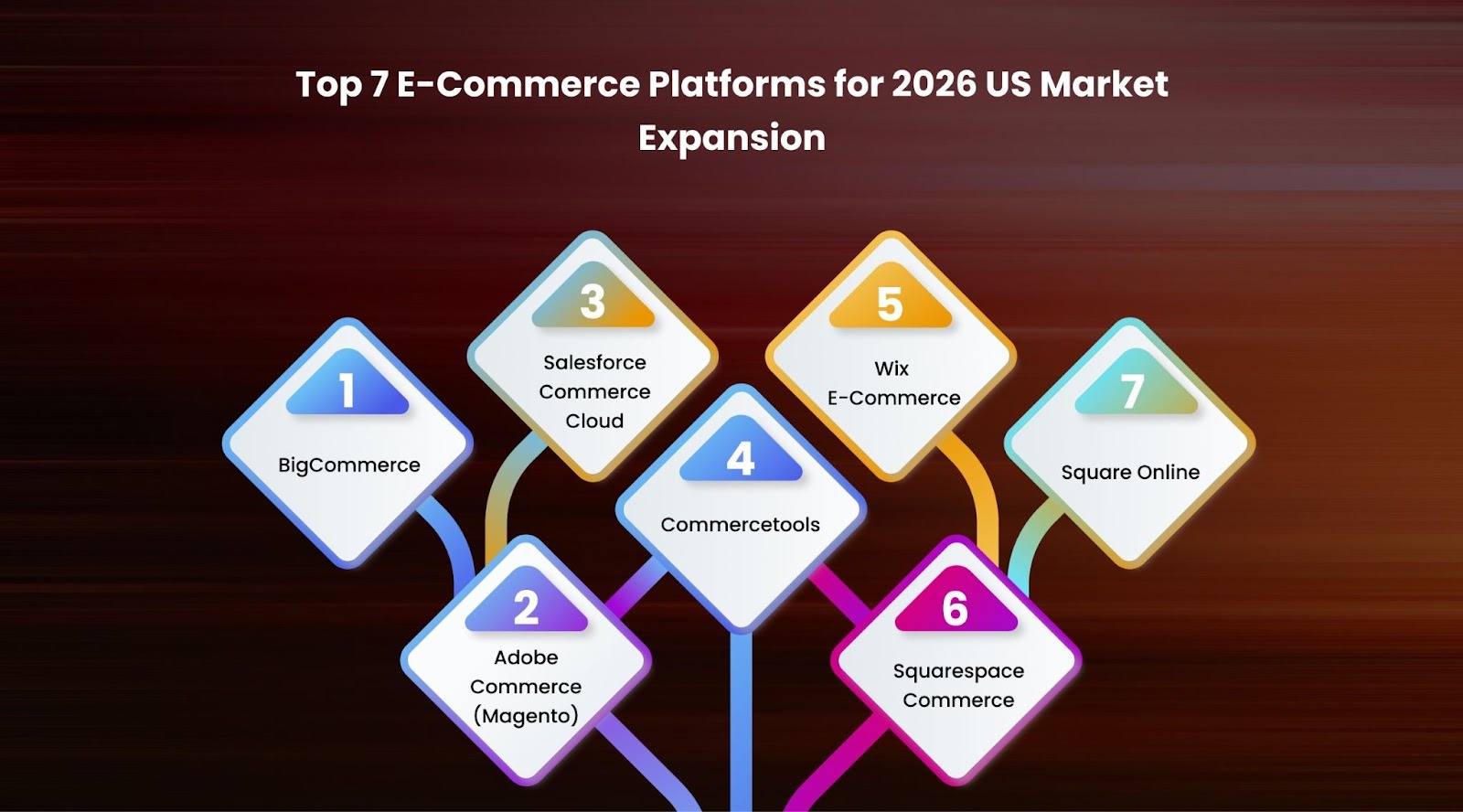
BigCommerce has become one of the best CMS for online stores in the US for brands looking for enterprise-grade capabilities without committing to a full composable build. It offers reliable performance, strong APIs, and less plugin dependency compared to WooCommerce and Shopify.
Adobe Commerce remains the go-to choice among the top enterprise e-commerce platforms for complex catalogs, deep customization, and multi-store setups. It gives technical teams complete control over architecture and experiences.
SFCC is one of the best cloud-based e-commerce platforms, built for enterprise businesses that rely on merchandising control, personalization, and data-driven experiences across all channels. This e-commerce platform is ideal for retailers managing massive catalogs, complex customer journeys, and high traffic volumes.
Commercetools is a preferred choice for API-first e-commerce platforms. It has become the flagship choice for teams that want complete architectural freedom. It’s ideal for brands planning to enter the US market with long-term scalability and innovation in mind.
Wix is best known for its intuitive drag-and-drop editor. It offers an accessible, easy-to-manage option for small teams that want control without coding. With built-in robust e-commerce features, it has become a top e-commerce platform for brands entering the US market.
Squarespace continues to dominate the design-first category, offering polished storefronts with low technical overhead and fast deployment. If your product heavily relies on beautiful images, it should be your go-to choice. Its templates are also mobile-optimized, ensuring brands always look impeccable.
Square Online brings storefronts, POS, payments, and fulfillment in a unified ecosystem. It’s ideal for brands, especially those that are selling both online and offline. With simplicity and deep hardware integration, it makes a perfect choice for brands expanding into the US market.
Choosing the right e-commerce platform heavily depends on your business profile versus the platform’s capabilities. Let’s take a look at the key questions you should be asking yourself:
At Unified Infotech, we help you answer all these questions. With over fifteen years of experience, we have been working with many e-commerce companies. Our experts will assess your unique business goals and help you find the right platform.
As you plan to enter the US market, keep an eye on these broader industry shifts shaping performance needs:
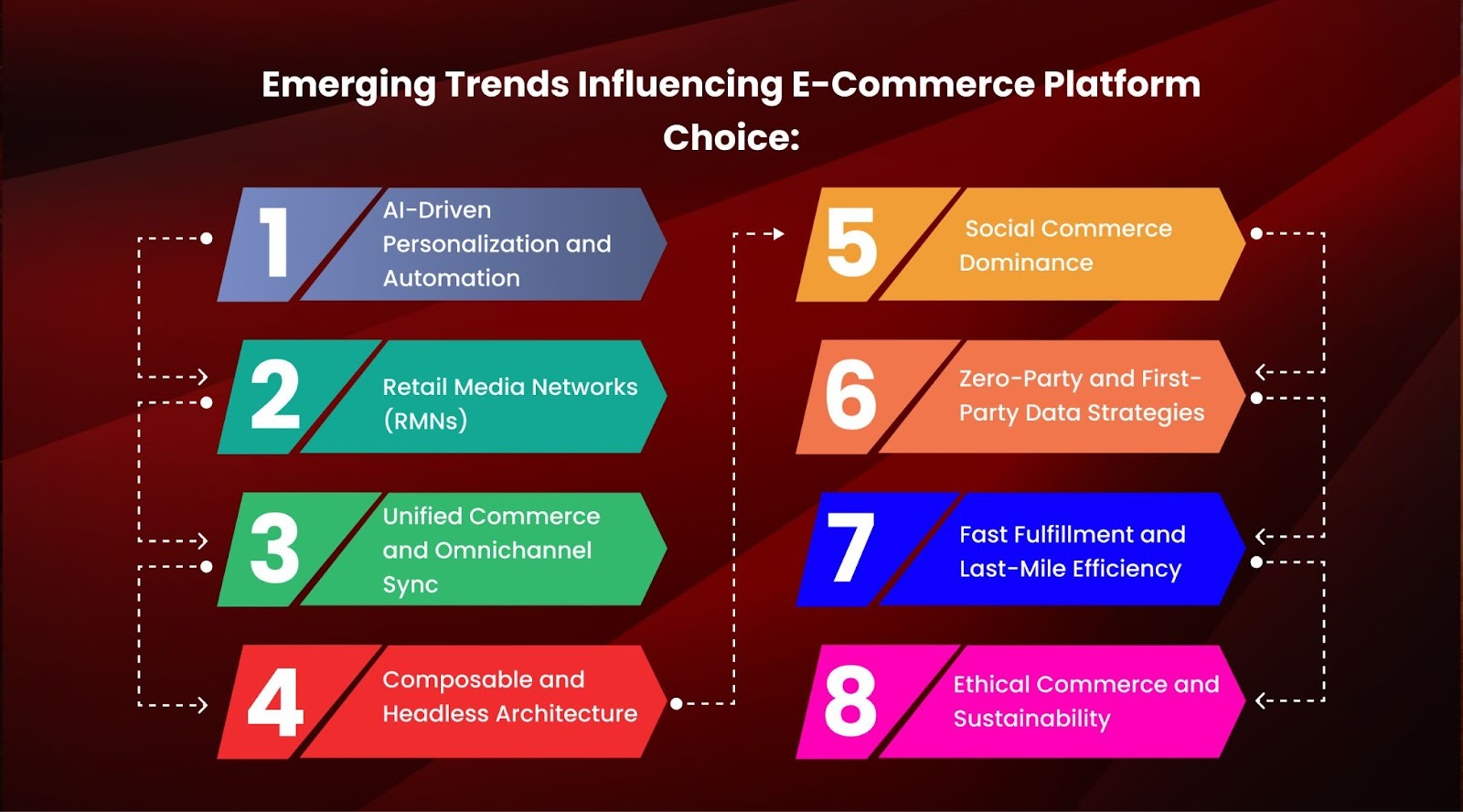
In 2026, expanding into the US market is more than just going live. It’s about choosing what scales smarter. The e-commerce industry is getting faster, more competitive, and shaped by customers who expect seamless interactions across every touchpoint. Hence, your e-commerce platform choice should support flexibility, performance, and effortless integrations to keep pace with how modern customers browse, compare, and purchase today.
We hope this guide to the best e-commerce platforms for US market expansion in 2026 gives you the clarity you need to align your technology choices with the real buyer behavior. By choosing the right platform, you set the foundation for seamless growth, better customer experiences, and long-term success in one of the world’s most competitive digital markets.
Unsure about where to begin? Unified Infotech can lead the way!
We can help!
As a leading e-commerce web development company, we work closely with brands to understand their goals to find the right platform fit and architect solutions that ensure long-term US growth. If you’d like personalized guidance, feel free to connect with us for a no-obligation consulting session. We’d be happy to walk you through what’s best for your business.

WooCommerce and Shopify remain the largest players in the overall e-commerce market. But for brands expanding into the US market in 2026, BigCommerce has emerged as a leading scalable alternative with stronger built-in features, enterprise readiness, and better long-term flexibility.
Emerging e-commerce platforms offer greater scalability, modern architecture, and stronger native features, such as headless and composable commerce. Unlike Shopify and WooCommerce, options such as BigCommerce, Commercetools, and Adobe Commerce are engineered to support faster performance, deeper integrations, and long-term growth in the US market.
Choose SaaS if you want faster setup, reliable performance, and lower maintenance. Choose open-source if you need complete control, deep customization, or complex architecture. The right choice ultimately depends on your technical resources, budget, and long-term growth in the US market.
Key trends include AI-powered personalization, headless and composable commerce, unified online-offline experiences, growth in social commerce, faster fulfillment expectations, and stronger data privacy requirements. These shifts are pushing e-commerce platforms to offer greater flexibility, performance, and integration capabilities for US-focused brands.
Platforms like BigCommerce, Square Online, and Salesforce Commerce Cloud offer some of the strongest US-based integrations, covering taxes, payments, fulfillment, and compliance. They provide localized tools, reliable hosting, and native connections that help brands scale smoothly in the US market.

"Tridibesh Sen, Technology Lead for PHP and WordPress, creates custom CMS solutions, plugins, and themes. He ensures site performance, security, and responsiveness, delivering optimized, SEO-friendly platforms tailored for client branding and user engagement.”