





Reach out, we'd love to hear from you!
MVP Success Blueprint
Identify the problem → Validate customer demand → Prioritize must-have features → Build the simplest usable version → Launch to a small audience → Collect real user feedback → Measure adoption & engagement → Iterate based on data → Refine product-market fit → Scale with confidence
The takeaway: Every step should aim to reduce uncertainty. The best MVPs are not feature-rich; instead, they are insight-rich, turning assumptions into validations before making a significant investment.
Startups celebrate speed. Founders compete to launch products, capture market share, and secure funding before their peers.
With all that said, despite the growing importance of lean product development, many Minimum Viable Products (MVPs) fail to achieve their intended outcomes.
What is the problem? Are companies not building MVPs?
No. The real problem is that teams often lack a proper understanding of what an MVP is meant to accomplish.
To be real, an MVP is not a stripped-down version of a completed product. Instead, it is a strategic validation tool that tests assumptions, gathers market feedback, and reduces business risk before making a significant investment.
MVP development, if executed correctly, allows organizations to identify demand, optimize resources, and accelerate product-market fit.
If not, it becomes a costly experiment that delivers little to no actionable insight.
For C-suite executives, having an in-depth understanding of why MVPs fail and how companies can successfully approach minimum viable product development is important. This will clarify the difference between a scalable product and a costly development.
CB Insights reports that most startups fail due to poor market fit (43%), while 70% eventually run out of cash. These numbers point toward a common theme: teams build before they validate. Thus, the discussions about why MVPs fail tend to focus more on business strategy than on technology.
Organizations often begin MVP development for startups based on assumptions rather than validation and evidence. They waste weeks and months developing features that are rarely required by their customers. Besides, they invest most of their capital in infrastructure before validating demand or approaching product launch to solve vague problems.
Some of the most common MVP development mistakes:
Conglomerates and successful enterprises have realized that the objective of MVP development is not to be absolutely perfect, but to learn from your mistakes and develop for the user.
One of the main reasons why MVPs fail is the confusion about validation frameworks. Before starting minimum viable product development, leaders must have an in-depth understanding of the distinction between MVPs, prototypes, and proofs of concept.
Let us understand this with the help of a table:
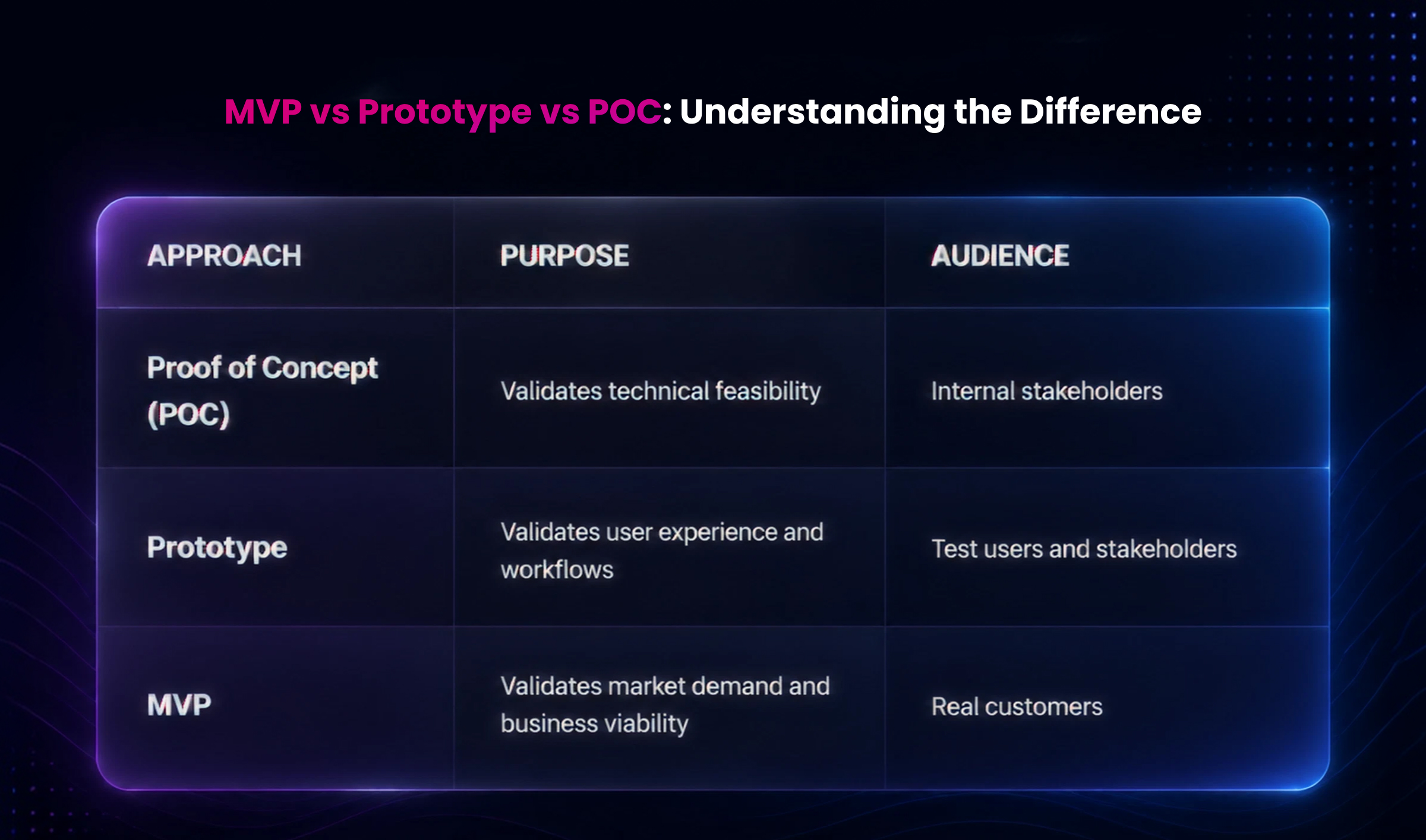
The distinction is crucial because each serves a different purpose in the MVP development lifecycle.
Organizations that skip this progression often encounter costly setbacks later in the product journey.
For a deeper understanding, read Prototype vs MVP: What’s the difference?
The most effective MVP development process begins long before a single line of code is written. High-performing product teams treat MVP creation as a structured validation framework rather than a development project.
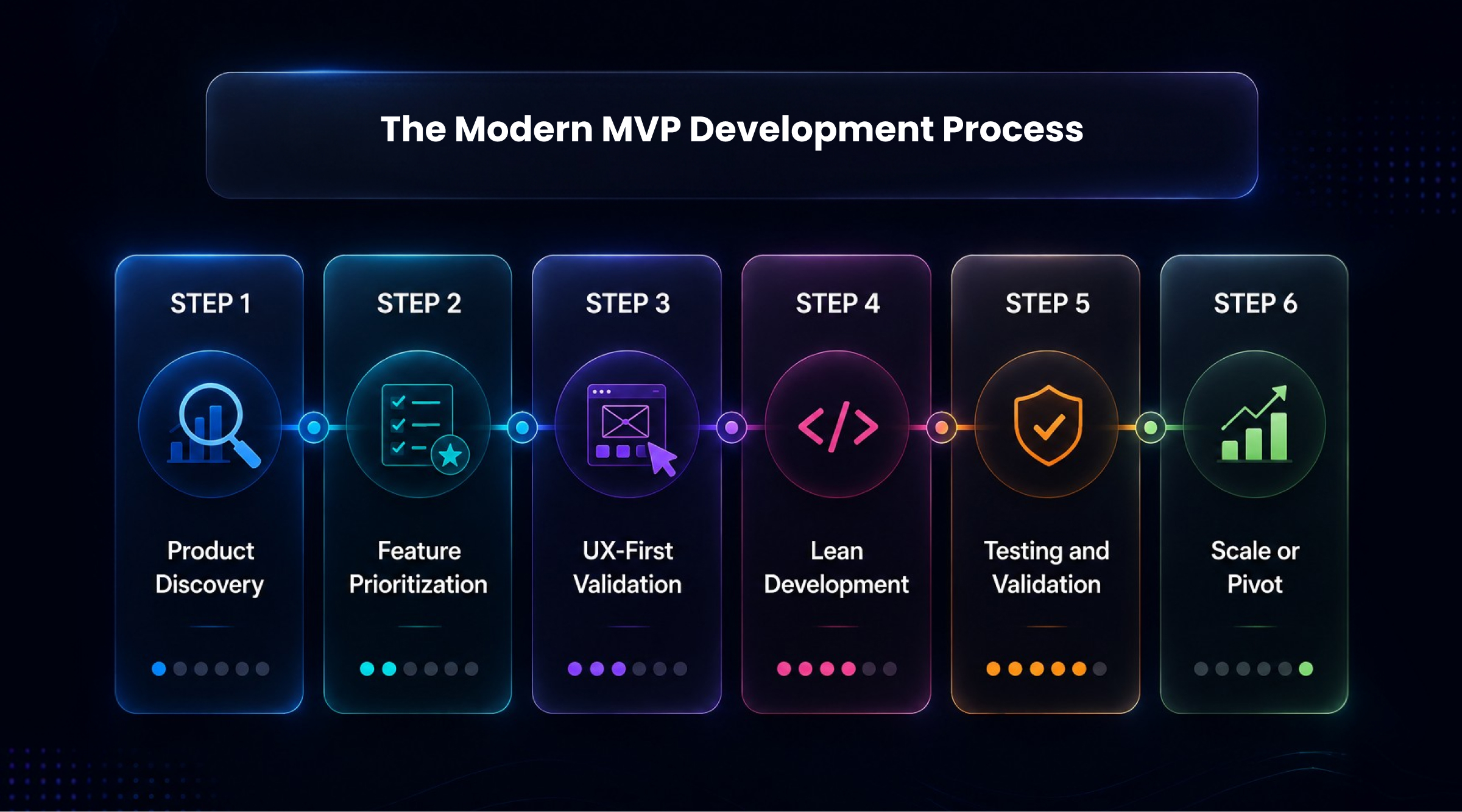
A successful MVP product development process typically follows six stages.
Every successful MVP development strategy begins with understanding customer pain points.
During the product discovery phase, teams:
This stage forms the foundation of effective startup product validation.
One of the most critical aspects of MVP feature prioritization is identifying features that directly test core business assumptions. Instead of asking:
“What features should we build?“
Ask:
“What assumptions must we validate?“
This shift dramatically improves the effectiveness of MVP product validation. Successful teams use frameworks such as:
Effective MVP feature prioritization prevents scope creep and keeps development focused on learning.
Strong MVP UX design is often overlooked. Many teams assume customers will tolerate poor experiences because the product is in its early stages. In reality, users judge value through usability.
Effective MVP UX design focuses on:
The goal is not visual perfection but validation of customer behavior.
Modern agile MVP development emphasizes iterative releases over large deployments. The most effective MVP development company partners follow lean startup methodology principles:
This approach enables faster learning while reducing risk.
An MVP without structured testing is merely a product launch. Effective MVP testing and validation focus on measurable outcomes:
This stage powers the broader MVP iteration process.
The final stage of the MVP development lifecycle is decision-making. Based on validated learning, organizations can:
This forms the basis of an effective MVP scaling strategy.
One of the most searched questions among founders is how to build an MVP.
The answer is surprisingly simple:
The lesson is clear.
When considering how to build a successful MVP step by step, focus on validation rather than completeness.
A practical framework for how to scope an MVP without overbuilding includes:
Anything beyond that risks unnecessary complexity.
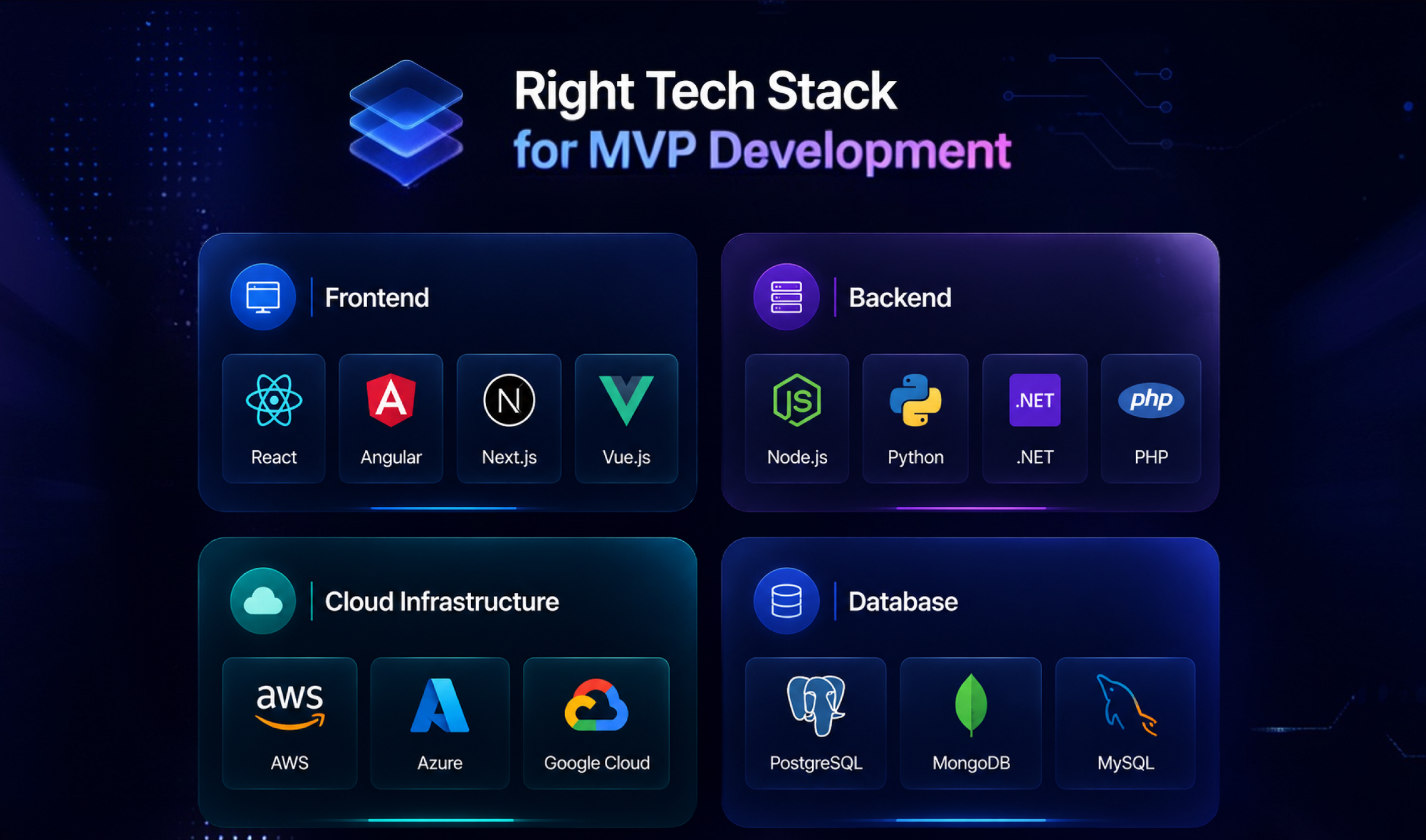
Technology decisions significantly influence both speed and cost. The best MVP tech stack selection balances speed, scalability, and maintainability. When evaluating the best tech stack for MVP development, CTOs should consider:
The objective of selecting an MVP tech stack is not to build for millions of users immediately. It enables rapid experimentation while supporting future growth through a scalable MVP architecture.
One of the most common executive questions involves MVP development cost. The reality is that the cost of MVP development varies significantly depending on:
A basic SaaS MVP may require a substantially smaller investment than a marketplace platform or an AI-driven application. However, the greater risk is not overspending. It is spending on the wrong features.
Organizations that invest heavily before validation often encounter the same challenges that lead to MVPs failing.
For a detailed breakdown, read “MVP development cost: What businesses need to know before building.”
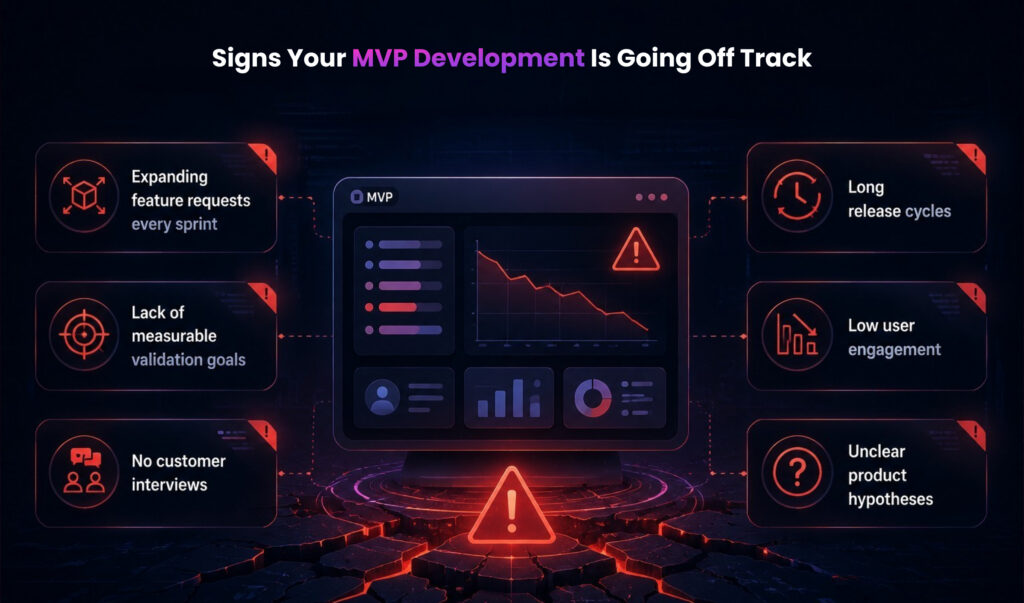
Recognizing failure early can save significant time and budget. Some common signs your MVP development is going off track include:
These indicators often signal deeper issues within the MVP product development strategy. The earlier these issues are addressed, the higher the probability of success.
AI is transforming custom software MVP development. McKinsey reports that developers who use generative AI can complete coding tasks faster than those who do not, accelerating product delivery and experimentation.
This shift is redefining rapid MVP development. AI-powered tools now assist with:
The global enterprise artificial intelligence market size is projected to reach USD 1,55,210.3 million by 2030 with a CAGR of 37.6%. Thus, integrating AI into MVP development services is becoming a strategic advantage. However, speed alone does not guarantee success. Validation remains the primary objective.
A strong MVP launch strategy focuses on learning, not scale. Many organizations make the mistake of treating an MVP launch as a full-scale product launch.
Instead, an effective MVP go-to-market strategy should:
This creates a sustainable MVP user feedback loop that fuels future development decisions. An effective MVP launch strategy also aligns marketing, product, and engineering teams around shared validation goals.
When evaluating what makes an MVP successful, the answer is rarely technical excellence alone.
The best MVPs share several characteristics:
These principles form the foundation of successful MVP development best practices.
Organizations that follow these principles create products that evolve based on evidence rather than assumptions.
Many businesses lack the internal expertise required for effective startup MVP development. Working with an experienced MVP development company provides access to product strategists, UX specialists, architects, and engineers who understand the nuances of validation-driven development.
The right custom MVP development company helps organizations:
Whether you’re pursuing SaaS MVP development, launching a digital platform, or exploring a new product category, expertise in MVP software development services can significantly improve outcomes.
For organizations evaluating long-term technology partners, explore why Unified Infotech is the top choice for custom software development and MVP software development.
Most MVPs fail for one simple reason: they are built to launch rather than to learn. Successful MVP development is not about releasing the smallest product possible. It is about designing the smartest possible experiment.
The organizations that succeed approach minimum viable product development as a structured validation framework. They prioritize learning over features, customer insights over assumptions, and iteration over perfection.
Whether you’re evaluating MVP development services, planning startup MVP development, refining your MVP product development strategy, or exploring a new MVP launch strategy, the goal remains the same:
Validate before you scale.
The best MVPs don’t succeed because they are built faster. They succeed because they are built smarter.
Want to build smart?

Building a successful MVP starts with validating a real customer problem, not just an idea. Define clear hypotheses, prioritize only core features, design intuitive user journeys, launch quickly to a targeted audience, and establish feedback loops. The goal is to learn, validate demand, and reduce risk before investing in full-scale product development.
Look for a partner with proven experience in startup and product development, strong discovery and validation capabilities, expertise in scalable architecture, and a transparent agile process. The right MVP development company should challenge assumptions, guide feature prioritization, and focus on business outcomes rather than just software delivery.
MVP development is the process of creating a minimum viable product with only the essential features needed to solve a specific user problem and validate market demand. It helps organizations test assumptions, gather real-world feedback, reduce development risk, and achieve product-market fit before making larger investments.
Most MVPs can be developed within 8-16 weeks, depending on complexity, integrations, and regulatory requirements. The ideal timeline prioritizes rapid validation over feature completeness, allowing teams to launch early, collect user insights, and iterate quickly based on actual market feedback.
MVP development costs typically range from $15,000 to $250,000+, depending on product scope, technology stack, integrations, UX complexity, and team location. The most cost-effective approach focuses on validating core assumptions first, avoiding unnecessary features that increase development effort without adding learning value.
An MVP should be scaled only after demonstrating consistent user engagement, validated demand, strong retention metrics, and a clear path to monetization. Scaling too early amplifies unproven assumptions, while scaling after achieving product-market fit enables sustainable growth with lower business and technical risk.

"Soumyodip De, PMO, Project/Program Management, oversees the planning and delivery of high-quality software. He implements frameworks to manage timelines, budgets, and risk, ensuring enterprise programs meet defined business objectives and KPIs.”